
Savings
Calculator
A savings calculator helps you figure out how much you need to save regularly to reach a specific financial goal within a defined time frame. It helps bring clarity by turning a vague goal into a structured, achievable target.
How does the savings calculator work?
Step 1: Enter your current savings balance
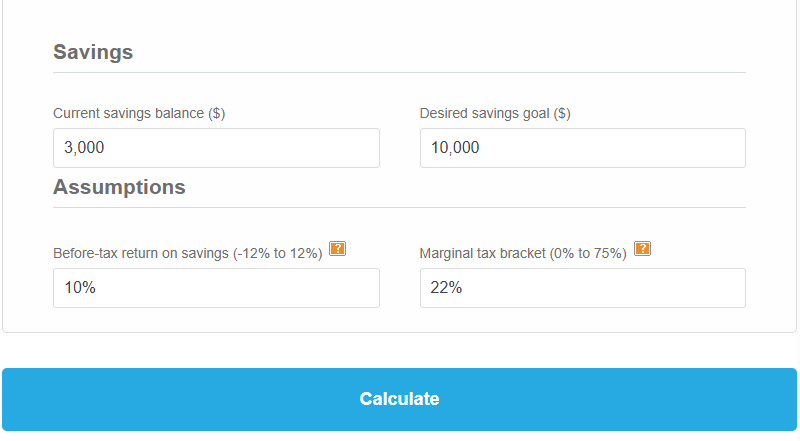
To start, enter the current balance in your checking/savings account. For example, if you currently have $3,000 saved up, enter the said amount.

Step 2: Input your desired savings goal
Next, enter the target amount you are saving for. For example, if you are saving for a down payment toward a home, say $10,000, enter the said value.

Step 3: Enter your before-tax return on savings (-12% to 12%)
Before-tax return on savings is the amount your savings earn before any taxes are deducted. For example, if your savings earn 10% annually, that 10% is your before-tax return.

Find & Compare Top Financial
Advisors in Your Area
Get Started
A better way to find the right financial advisor
Step 4: Determine your federal tax bracket (10% to 37%)
Your federal marginal tax bracket depends on your income level and filing status. You need to enter the tax rate so the calculator can estimate the impact of taxes on your investment returns. For example, if you are a single filer with income between $50,401 and $105,700, you will fall into the 22% federal tax bracket. It is important to check the latest IRS tax brackets to ensure accuracy.

Step 5: Review your results
Once you have entered all the data, you can click on calculate. The calculator will estimate how much time it will take to reach your desired savings goal after factoring in the amount of taxes paid by you.

I Want to Take Charge.
Help me find and compare top vetted
financial advisors in my area.
FINRA/SEC Registered Advisors
 Your Information is Safe and Secure
Frequently Asked Questions
This helps the calculator estimate how your savings will grow over time. It uses this rate to project earnings before tax.
Taxes reduce the returns you earn on your savings. By factoring in your tax bracket, the calculator provides a more realistic estimate of how long it will take to reach your goal.
Yes, you can. You may use it for goals such as a down payment on a home, an emergency fund, education, or any planned expense.
Increasing your contributions can help you reach your goal faster or reduce the reliance on investment returns.
Related Guide